
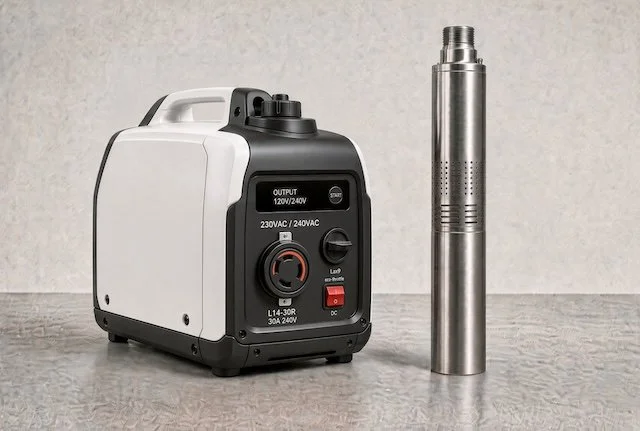
Generators and Power Usage: How Much Power Does My Submersible Well Pump Need/Use?
Many of our readers have been searching for ways to keep their well pump equipment running during power outages. Our blog on correctly sizing generators has been quite popular, but we only covered the basics of determining pump size in that article. What if you don’t know the size of your pump and need to choose the right generator? In this post, we’re going to dive deeper to help you figure out how much power your submersible well pump consumes—whether in horsepower, amperage, or watts—while it’s running.
Finding Your Pump’s Power Information
Both submersible and above-ground pumps typically have a label that lists essential details like horsepower, kilowatts, amperage, and the required voltage. If the pump is clean and well-maintained, the label is usually easy to find on an above-ground pump. However, submersible pumps are a different story. Since they’re often hundreds of feet underground, locating the necessary information can be tricky.
Submersible pumps generally have a control box where the electrical wiring from the well connects. This control box typically has a label on the outside. Some manufacturers or installers also place additional labels inside the box. To access these internal labels, you may need to unscrew the control box cover, but make sure to shut off power to the pump and follow proper electrical safety procedures before you do this.
If your submersible pump uses a variable frequency drive (VFD) or constant pressure controller instead of a control box and pressure switch, check out our blog post About VFDs, which discusses generator sizing for residential pump systems with VFD controllers.
Can’t Find the Label? Here’s What to Do Next
If the label is missing or illegible, don’t worry—you still have options. First, try contacting the contractor who installed the well pump. They may have an invoice with details on horsepower, wire size, pipe dimensions, and the depth of the pump. This information is crucial not just for generator sizing, but also for future pump replacements.
If you can’t track down the installer or don’t have any records, look for the circuit breaker dedicated to your well pump. Most submersible pumps are single-phase, 230-volt systems that require a two-pole circuit breaker (two connected individual breakers). Check the amperage rating on the breaker—it can help estimate the size of the pump based on the National Electrical Code (NEC) and the Franklin AIM Manual.
Using Circuit Breaker Sizes to Estimate Pump Power
Here’s a breakdown of what different circuit breaker sizes can tell you about your pump and generator needs:
15-amp breaker: This indicates a pump smaller than 0.5 HP, using ~5 amps/700 watts. A 1.2 KW internally regulated generator is needed to start and operate the pump.
20-amp breaker: A pump under 0.75 HP, consuming ~8 amps/1100 watts. A 2 KW internally regulated generator is required. (1 HP pumps sometimes use a 20-amp breaker.)
25-amp breaker: This means a 1 HP or smaller pump, drawing ~9 amps/1400 watts. A 2.5 KW generator is needed.
30-amp breaker: Pumps smaller than 2 HP, using ~13 amps/2300 watts, require a 4 KW generator. (A 1.5 HP pump on this breaker needs a 3 KW generator.)
40-amp breaker: Indicates a pump smaller than 3 HP, consuming ~16 amps/3200 watts, requiring a 5 KW generator.
50-amp breaker: This indicates a pump smaller than 5 HP, drawing ~25 amps/5300 watts, and needing a 7.5 KW generator.
Why Is the Circuit Breaker Size Larger Than the Pump’s Operating Amperage?
You may have noticed that the circuit breaker rating is much higher than the amperage the pump uses during normal operation. This is by design! The breaker is sized to handle the high inrush current when the pump starts up. Once the pump reaches its running speed, the current draw drops to its normal level. This is why when selecting a generator, you should size it based on the starting current (circuit breaker size) rather than the running current. For more details, refer to the Franklin AIM Manual.
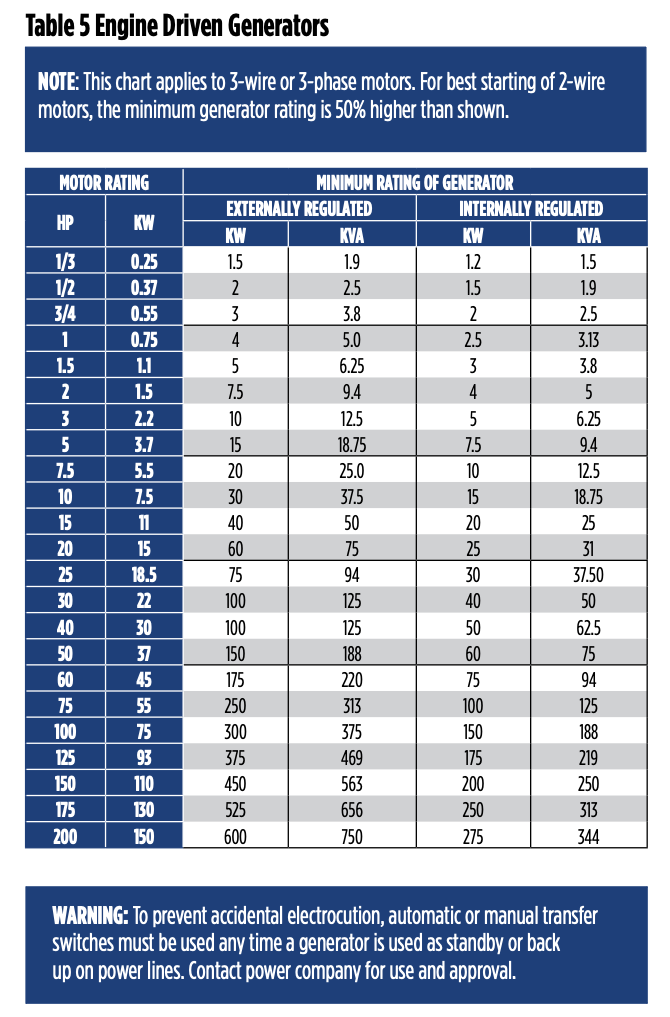
Franklin AIM Generator Sizing Chart
External Vs. Internal Regulated Generators:
In short: externally regulated = external AVR that senses voltage and compensates; internally regulated/self-excited = extra stator winding that senses current and self-adjusts. Most portable generators people use for well pumps fall into the externally regulated category.
These are general guidelines based on typical continuous-duty generators with ~80 °C rise and a maximum 35% voltage dip during start. Franklin always recommends checking the specific generator manufacturer’s data, especially on larger sizes.
Understanding the Power Rating of Your Pump
You might also be wondering why a 1 HP pump consumes 1400 watts when high school physics taught you that 1 HP equals 746 watts. The discrepancy arises because pumps are rated by the actual usable work (flow/pressure) they perform after accounting for inefficiencies in the electrical and mechanical systems. So, while the pump produces 1 HP worth of water flow, it consumes more power due to these inefficiencies.
Choosing the right pump for your well can improve efficiency and reduce costs. Check out our blog on selecting the most efficient pump for your needs, which can save you money both initially and in the long run.
What If You Can’t Find the Information?
If you’re still unable to locate the circuit breaker or label and don’t have any records, it may be time to call in a professional. An expert can measure the pump’s current draw and other electrical characteristics to give you a clear idea of its size and power consumption. Expect to pay around $200 for a professional to assess the pump system and offer suggestions.
Keep the Information Handy
Once you’ve figured out the pump’s power usage and specifications, make sure to document it and keep it in a safe place. Knowing your pump’s power needs is essential not just for generator sizing but also for future maintenance or replacement.